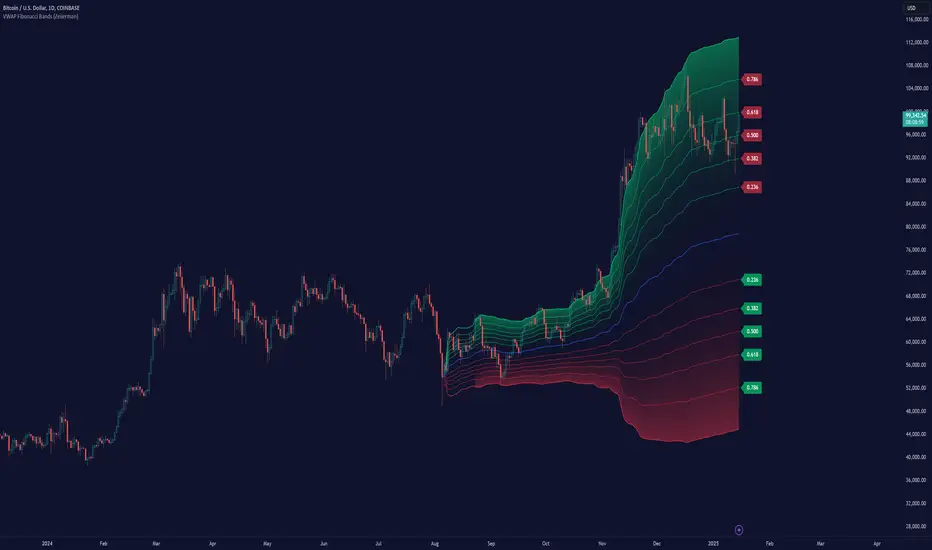
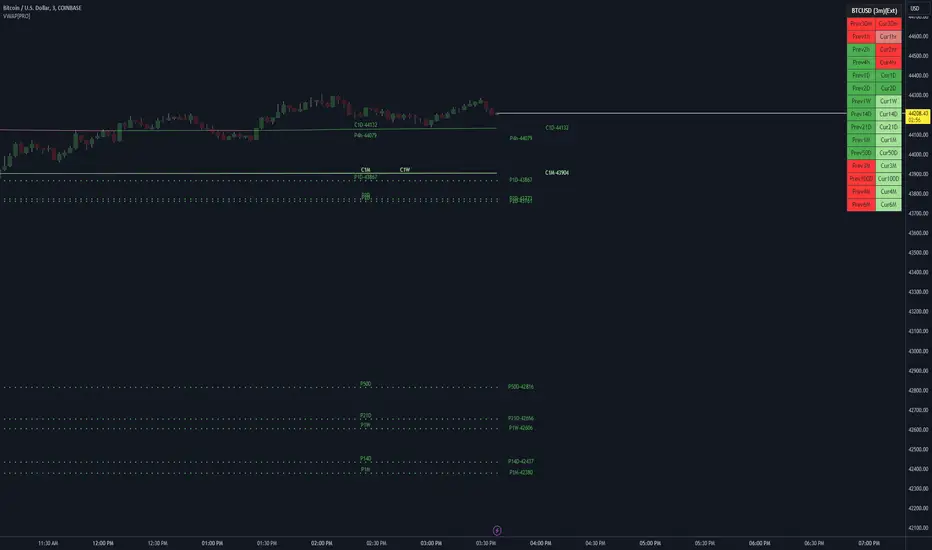
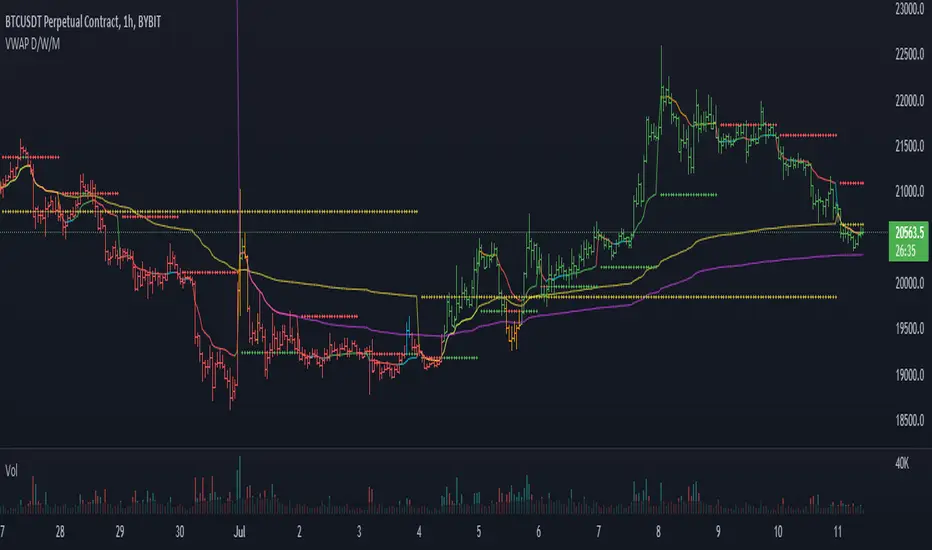
Rolling VWAP + Bands (Tighter Option) + 2.35/3.0 Re-entry AlertsRolling VWAP + σ Bands — How to Trade It
This indicator plots a Rolling VWAP (a volume-weighted mean over a fixed bar window) along with standard deviation (σ) bands around that VWAP. The goal is simple:
Quantify “normal” price distance from value (VWAP)
Highlight statistical extremes and pullback zones
Trigger re-entry signals when price returns from extreme deviation back inside key bands (±2.35σ and ±3σ)
It’s designed for scalping and short-term decision support, especially on lower timeframes.
What the Lines Mean
VWAP (Rolling Window)
The VWAP line represents the rolling “fair value” of price, weighted by volume across the lookback window.
In ranges: VWAP acts like a gravity center
In trends: VWAP acts like a dynamic mean that price may pull back toward before continuing
σ Bands (Standard Deviation)
The σ bands show how far price is from VWAP in statistical terms:
±1σ: Normal variation
±1.5σ: Common pullback / continuation zone in trends
±2σ: Extended move / trend stress
±2.35σ: Deep extension (often a “stretched” market)
±3σ: Rare extreme (often emotional moves / liquidation wicks)
The Most Important Feature: 2.35σ and 3σ Re-entry Signals
A Re-entry signal fires when price was outside a band on the previous bar and closes back inside that band on the current bar.
Why this matters:
The market pushed into an extreme zone…
…then failed to stay there
That “failure” often leads to a snap-back toward value (VWAP) or at least toward inner bands.
In general, a 3σ re-entry is stronger than a 2.35σ re-entry, because it represents a more statistically extreme excursion that couldn’t hold.
These are not “magic reversal calls” — they’re high-quality mean-reversion triggers when conditions favor mean reversion.
Regime 1: Contracting Bands = Mean Reversion Environment
What contracting bands imply
When the bands tighten / contract, volatility is compressed. In this environment:
Price tends to oscillate around VWAP
Deviations are more likely to mean revert
Extremes are clearer and usually followed by a return toward value
How to trade mean reversion with this indicator
Core idea: fade extremes and target VWAP / inner bands.
A) Highest quality setups: 2.35σ and 3σ re-entries
These are your “strongest” mean reversion events.
Short bias setup
Price closes outside +2.35σ or +3σ
Then re-enters back below that band (signal)
Typical targets: +2σ → +1.5σ → VWAP (depending on momentum)
Long bias setup
Price closes outside −2.35σ or −3σ
Then re-enters back above that band (signal)
Typical targets: −2σ → −1.5σ → VWAP
Why these work best in contraction:
The market is statistically “stretched”
With low volatility, it’s harder for price to stay extended
Re-entry often starts the “snap-back” leg
B) Scaling / partial targets (optional approach)
If you manage positions actively:
Take partial profits at inner bands
Use VWAP as the “magnet” target when conditions remain range-bound
Risk framing for mean reversion
Mean reversion fails when price keeps walking the band and volatility expands.
Common failure clues:
Bands begin to widen aggressively
Price repeatedly holds outside outer bands
VWAP slope starts to accelerate in one direction
If that starts happening, the market is likely shifting to a trend regime.
Regime 2: Expanding Bands + VWAP Slope = Trending Environment
What trending conditions look like
Trends typically show:
VWAP sloping consistently
Bands expanding (higher volatility)
Price spending more time on one side of VWAP
Pullbacks that stall near inner/mid bands instead of reverting fully
In this environment, fading outer bands becomes lower probability because price can “ride” deviations during strong directional flow.
How to trade continuation with this indicator
Core idea: use VWAP and inner bands as pullback zones, then trade in the direction of the VWAP slope.
A) Trend continuation zones (most practical)
VWAP: first pullback level in mild trends
±1σ: shallow pullback continuation
±1.5σ: higher-quality pullback depth in stronger trends
±2σ: deep pullback / trend stress (more caution)
Example (uptrend):
VWAP rising
Price pulls down into VWAP / +1σ / +1.5σ area
Continuation entries are considered when price stabilizes and pushes back with the trend
Example (downtrend):
VWAP falling
Price pulls up into VWAP / −1σ / −1.5σ area
Continuation entries are considered when price rejects and rotates back down
What to do with 2.35σ / 3σ re-entry signals in trends
Re-entry signals can still occur in trends, but they should be interpreted differently:
In strong trends, an outer-band re-entry may only produce a brief bounce/rotation, not a full mean reversion to VWAP.
Targets may be more realistic at inner bands rather than expecting VWAP every time.
In other words:
Range: outer-band re-entries often aim toward VWAP.
Trend: outer-band re-entries often aim toward 2σ / 1.5σ / 1σ first.
Practical Regime Filter (simple visual read)
This script intentionally doesn’t hard-code a “trend/range detector,” but you can visually infer regime quickly:
Mean reversion bias
Bands contracting or stable
VWAP mostly flat
Price crossing VWAP frequently
Trend continuation bias
Bands expanding
VWAP clearly sloped
Price holding mostly on one side of VWAP
Notes on σ Calculation Options
This indicator includes σ mode toggles:
Unweighted σ (tighter): treats price deviations more “purely” and often gives bands that react more tightly to price behavior.
Volume-weighted σ: emphasizes high-volume price action in the deviation calculation.
Both are valid — test based on your market and timeframe.
Summary Cheat Sheet
Contracting bands (range / compression)
Favor: mean reversion
Best signals: 2.35σ and 3σ re-entry
Typical targets: inner bands → VWAP
Expanding bands + sloped VWAP (trend)
Favor: continuation
Use pullbacks to: VWAP / 1σ / 1.5σ as entry zones
Outer-band re-entries: treat as rotation opportunities, not guaranteed full reversals
Penunjuk Pine Script®